
Mediterranean Architecture
Modern Mediterranean design
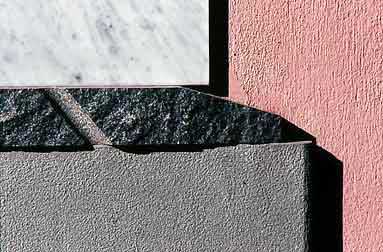
Marble, limestone and granite waste cladding by Francesco Saverio Alessio; San Giovanni in Fiore, 2000
Beyond the goldsmith tradition, in the course of the History, the woven is the one that characterized the handicraft production of San Giovanni in Fiore, with bedspreads and trousseaus with strongly coloured geometrical motifs, some directly inspired by those of the Ellenic colonists who in their turn had been instructed by Persian craftsmen. It’s useless to say that, beyond small sporadic examples, currently this tradition is practically extinct.
With various expressive techniques and various functions, in the course of the years, in my works on several occasions (as an example mine are the panels in coloured granite mosaic on the road crossing between the sport field and the cemetery; Palla-Palla, summer 2000), re-appear the motifs and the colours of the bedspreads of my early childhood.
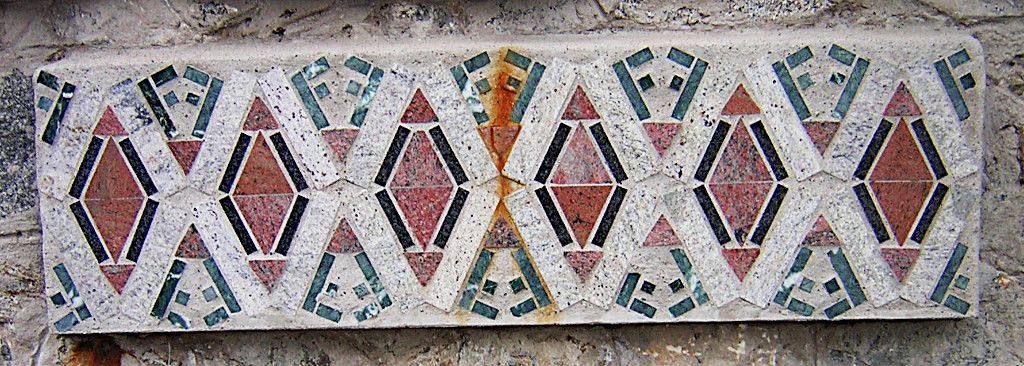
Marble and granite mosaic by Francesco Saverio Alessio; © copyright, 2000
Also i remember the laboratories of blacksmiths, carpenters, stonemasons; the smells, the noises, the tales. Gestures of these craftsmen, the mediterranean daily character of their work, they are imprinted in my being.
When I design some decorative work, I think about the way in which the blacksmith, the carpenter, the marble worker will do it, how they will be able to interpret it. I manage a work of a team of interpreters.
Like them I love stones, wood, iron, glass...
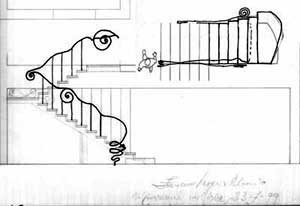
Of the wrought iron balustrade, in addition to the dimensional drawings and sketches, I molded an architectural model in wire at a scale of 1:10: the passionate skill in modeling hard metal with fire, inseparable for me, Maestro Antonio Cimino, Wrought iron artist, and the craftsmanship of the Maestri Fratelli Pupo, marble craftsmen, have made my "Fantasy" as a Designer concrete.
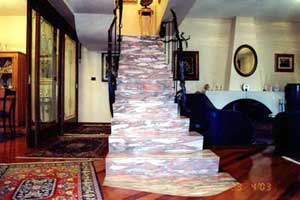
Apartment
photography: Francesco Saverio Alessio © copyright & all rights reserved 2000
Wrought iron curlicues and open book norvegian pink marble for the apartment in San Giovanni in Fiore, 2000
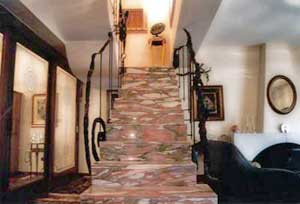
Apartment
photography: Francesco Saverio Alessio © copyright & all rights reserved 2000
Wrought iron curlicues and open book norvegian pink marble for the apartment in San Giovanni in Fiore, 2000
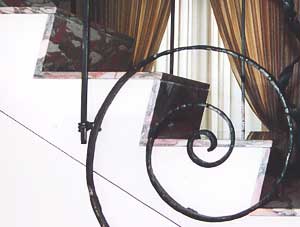
Wrought iron curlicues
photography: Francesco Saverio Alessio © copyright & all rights reserved 1997
Wrought iron curlicues and open book norvegian pink marble for the apartment in San Giovanni in Fiore, 2000
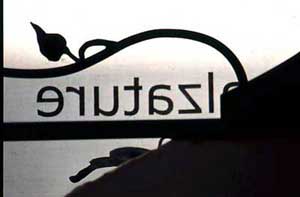
Store windows
photography: Francesco Saverio Alessio © copyright & all rights reserved 2001
Wrought iron, travertine and walnut wood for store windows of "Gallo Calzature" in San Giovanni in Fiore, 2001
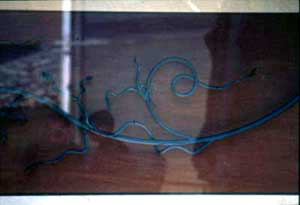
Store windows
photography: Francesco Saverio Alessio © copyright & all rights reserved 2001
Wrought iron, travertine and walnut wood for store windows of "Gallo Calzature" in San Giovanni in Fiore, 2001

Store windows
photography: Francesco Saverio Alessio © copyright & all rights reserved 1997
Steel section and polychrome marbles for store windows, travertine, mirror and walnut wood for the interior of "C&C Hair-dress Workshop" in San Giovanni in Fiore, 1997
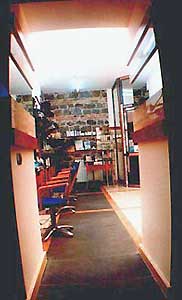
C&C Hair-dress Workshop
photography: Francesco Saverio Alessio © copyright & all rights reserved 1997
Travertine, mirror and walnut wood for the interior of "C&C Hair-dress Workshop" in San Giovanni in Fiore, 1997

Apartment building
photography: Francesco Saverio Alessio © copyright & all rights reserved 2001
Plinth in granite waste and polychrome marbles for apartment building in San Giovanni in Fiore, 2001
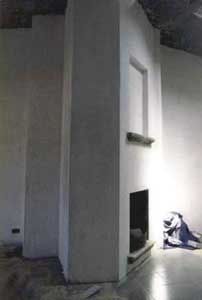
Apartment
photography: Francesco Saverio Alessio © copyright & all rights reserved 1987
Fireplace in light plaster with material of bare of Middle Ages for the apartment in San Giovanni in Fiore, 1987
Links
This is a section of the site dedicated to the Mediterranean Architecture and that, going from the Mezquita de Cordoba to the Tiberius's Villa Iovis in Capri, from the Adalberto Libera's Villa Malaparte always in Capri until the Francesco Venezia's Gibellina Museum, from the Le Corbusier's Ronchamp Chapel to the Abbazia Florens of Gioacchino da Fiore and Luca Campano through the undergrounds of Naples, the underground architecture of the Greek Roman caverns exposed to the XVII Triennale of Milan, the ages, the cultural migrations, the Urbanism and Etno-Psychiatry, sometimes the losses, sometimes the contaminations, through various values and the religions, the aesthetic valences, with the contribution of personal written and of others Authors, of photography's, designs and other types of iconographic representations, 3d rendering, cad, videos, wants indicate a reflection course on this argument.